
The Ceramic Pan Flutes of the Nasca

When we think of an Andean pan flute today, we usually imagine rows of bamboo or cane tubes tied together. During a recent visit to the Museo de Arte de Lima (MALI), however, I encountered a very different version of the instrument. The exhibit showcased a series of ceramic antaras made by the Nasca culture on the southern coast of Peru.
The examples displayed at MALI date broadly from 50 to 650 CE. They are not ceramic representations of pan flutes. They are pan flutes. It is important to emphasize this distinction. These objects were made to organize columns of air into sound, much like the pan flutes played in the Andes today. But their material changes how we encounter them. Their tubes were modeled in clay and painted. The result is an instrument that belongs simultaneously to the history of music and to the extraordinary ceramic tradition for which the Nasca are known.
And looking at them in the museum, I found myself wondering whether those two dimensions can really be separated.
Ceramic seems, from a modern perspective, an unusual material for a wind instrument. Cane already provides a hollow tube while clay requires the tube to be constructed. Yet ceramic antaras were particularly important among the Nasca. Archaeomusicologist Anna Gruszczyńska-Ziółkowska has described the antara as the principal melodic instrument of Nasca culture. Research on surviving instruments shows that their construction was sophisticated. The different tubes were formed to create particular pitches, and the resulting instruments suggest an organized conception of musical intervals rather than an arbitrary collection of sounds.
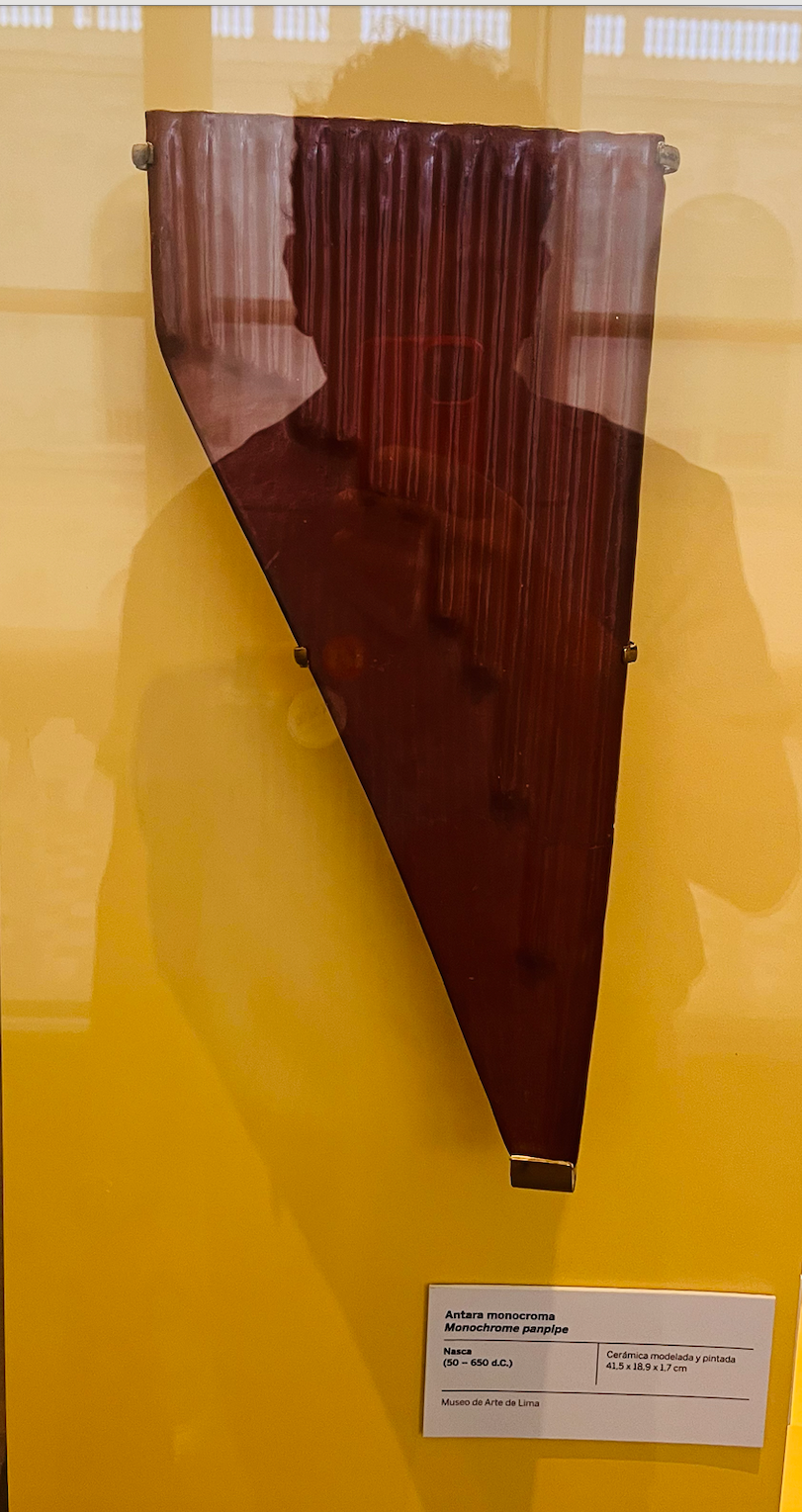
One of the MALI instruments makes the physical logic of the instrument clear. Its undecorated upper section shows the succession of tubes, increasing in length across the body of the antara. What looks from a distance like a triangular ceramic object is actually a sequence of enclosed resonating spaces. The ceramic piece is not just a surface for decoration. It is primarily an organized acoustic structure .

And because the tubes are made from clay rather than cut from naturally hollow reeds, producing the instrument requires creating those spaces. That interests me because the Nasca antara is literally an architecture for breath. Air enters an opening, encounters a carefully constructed cavity, and returns as sound.
But the Nasca did something else with these objects. They painted them.
The four antaras displayed at MALI show different approaches to decoration.
One is labeled simply “Antara monocroma.” Its dark reddish surface is relatively restrained, allowing the long parallel tubes themselves to dominate the object.
Another, considerably smaller instrument, is tricolor. White occupies the upper section containing the mouths of the pipes, while bands of red and a much darker color organize the lower body.
A third transforms the surface into a geometric composition. Horizontal bands divide the instrument while a central field contains repeated diamond-shaped figures.
And perhaps the most striking example carries a human figure. MALI describes it as an "Panpipe decorated with a male figure carrying shafts in his hands and surrounded by small stalks." The figure occupies the upper portion of the instrument, surrounded by vertical elements that visually echo the pipes from which the antara is constructed.

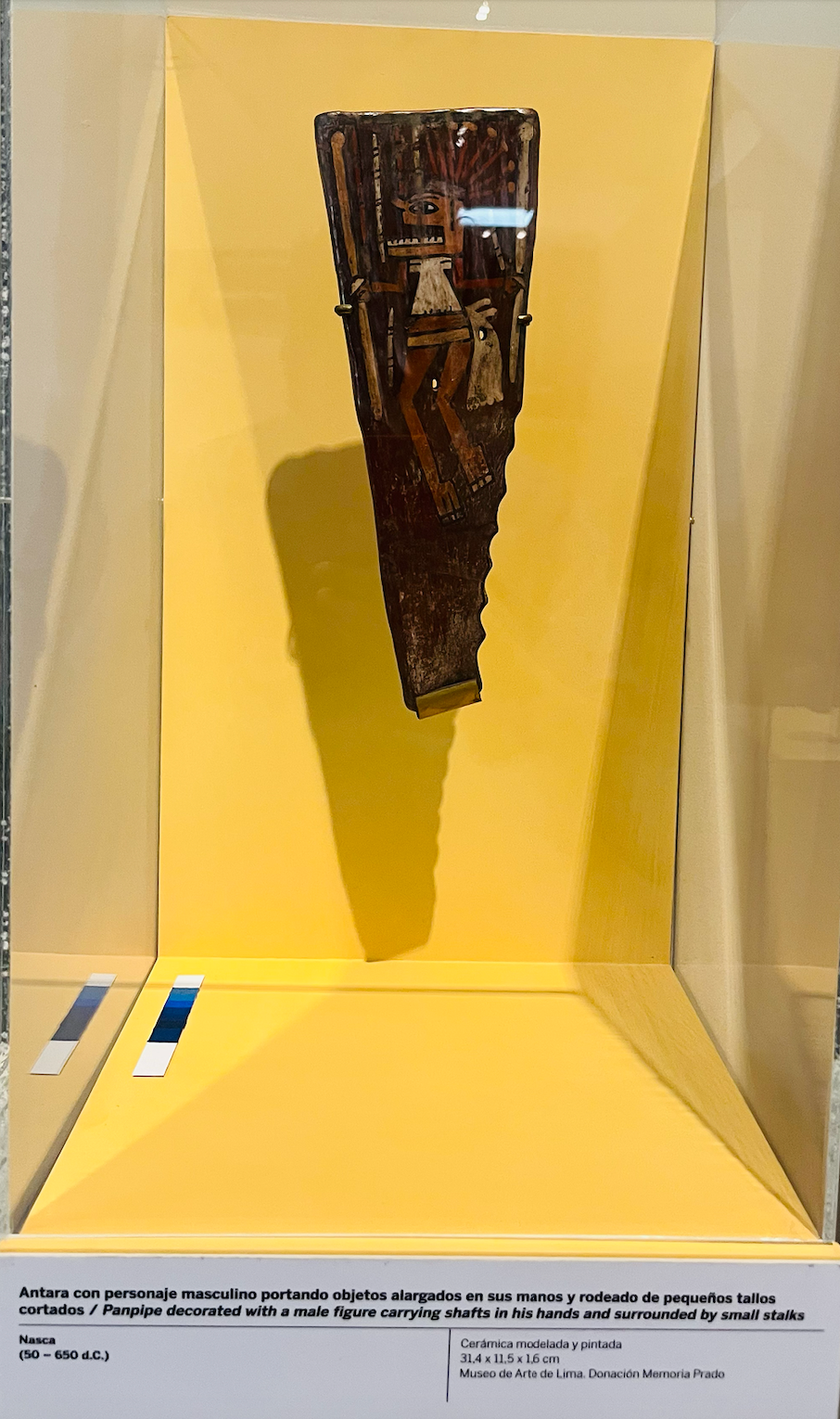
One should be careful about assigning a precise meaning to this scene without knowing more about its iconographic context. Nasca instruments elsewhere, however, frequently carry anthropomorphic and zoomorphic imagery within a supernatural context. A surviving Early Nasca antara at the Princeton University Art Museum, for example, is decorated with a complex supernatural figure (you can see by clicking this link), while other Nasca panpipes similarly use the instrument as a surface for polychrome imagery.
The decoration does more than make the instrument beautiful. At the very least, it tells us that the visual appearance of the antara mattered alongside its sound. Perhaps the two dimensions were not meant to be separated at all. What the instrument produced was not just sound, but an event in which sound, visual appearance, performance, and context converged.
Behind glass, we see their dimensions, colors, pipes, wear, and iconography. But the property around which the instrument was constructed, that is, the movement of air through it, is what the museum cannot give us. Archaeology provides some clues.
Excavations at Cahuachi, the great Nasca ceremonial center, uncovered a group of twenty-seven ceramic antaras deposited together as an offering. Their preservation has allowed researchers to investigate both how the instruments were manufactured and the pitches they could produce. The resulting studies suggest a musical world concerned with interactions between pitches that could generate complex acoustic effects. In other words, pan flutes were designed for dynamic interplay rather than individual performance.
The archaeological context is significant. Musical instruments occur at Cahuachi in contexts connected with ceremony and collective activity, and scholars have proposed that music accompanied gatherings and processions there. The presence of large numbers of panpipes, whistles, drums and other instruments suggests that sound was an important component of Nasca ceremonial life.
It is tempting, then, to look at one of these antaras and imagine an individual musician playing a melody. But perhaps that image is incomplete. An antara played beside other antaras produces a field of interacting sounds: breath, pitch, resonance, beating, consonance and dissonance. What survives in the museum is one component of what may once have been a much larger sonic event.
One can say that there is something paradoxical about encountering these objects at MALI. The museum allows us to examine them with an intimacy that their original listeners may never have had. We can stand still before an antara, study the painted diamonds on its surface, count its tubes, and compare its proportions with those of another instrument nearby. Yet we encounter it under conditions very different from those in which it originally existed. No breath passes through its tubes, no musician holds it, no other antara sounds beside it nor are they embedded in the ceremonial and collective contexts in which many such instruments appear to have been used. What survives is the ceramic object, while the musical event itself has disappeared.
The Nasca antara is difficult to understand as either a musical instrument or a decorated ceramic object alone. Its visual and acoustic dimensions belong to the same artifact. The painted body that we now see behind glass was also an arrangement of cavities intended to receive breath and transform it into sound. It prompts us to think of the sound produced as an event rather than only sound. Perhaps this is what I found most striking about seeing these instruments at MALI. Although the musicians and the rituals are gone, something of the act of playing remains materially preserved in the shape of the clay.
Ron
Works Cited
Gruszczyńska-Ziółkowska, Anna. “Variedad sonora de las antaras nasca: ¿Un caos o el sistema?” Revista Española de Antropología Americana, vol. 39, no. 1, 2009, pp. 145–168.
Gruszczyńska-Ziółkowska, Anna. “Nasca Antaras and Whistles: A Musicological Study.” The Ancient Nasca World: New Insights from Science and Archaeology, edited by Rosa Lasaponara, Nicola Masini, and Giuseppe Orefici, Springer, 2016, pp. 375–396. doi:10.1007/978-3-319-47052-8_17.
Orefici, Giuseppe. “The Functions and Distribution of Space in the Urban and Religious Centers of the Río Nasca Valley.” The Ancient Nasca World: New Insights from Science and Archaeology, edited by Rosa Lasaponara, Nicola Masini, and Giuseppe Orefici, Springer, 2016, pp. 181–196. doi:10.1007/978-3-319-47052-8_9.


Comments